China Top 10 Power Lift Chair Manufacturers for Buyers?
Choosing a reliable supplier is a practical decision, not just a search for a low unit price. Power lift chairs must raise and recline smoothly, support users comfortably, and hold up to regular use. For buyers comparing China-based manufacturers, details such as motor configuration, frame construction, upholstery options, controls, and available sizes deserve careful attention.
This guide introduces ten manufacturers for buyers to research, rather than treating any ranking as a guarantee of quality. A polished catalog can look convincing. Looks can mislead. Ask for current product specifications, factory or quality-control information, sample terms, and clear details about warranties and spare parts. If a supplier cites certifications or test results, confirm that the documents apply to the specific product and market you are considering.
Commercial terms matter, too. Compare minimum order quantities, customization limits, packaging, production lead times, and communication during order changes. A lower quote may exclude useful options or after-sales support; clarify what is included before comparing prices. Where possible, assess a sample in person and test the lift and recline movements, remote control, and finish. That takes time. It can also expose small issues that photographs miss.
No shortlist can replace careful checks tailored to your customers and sales channel. Manufacturers differ, and information can change. Use the profiles that follow as a starting point, then request written answers and verify key claims independently. A good buying decision should feel clear, even if the process is not perfect.
Define China’s Power Lift Chair Market and Its 2- and 3-Motor Designs
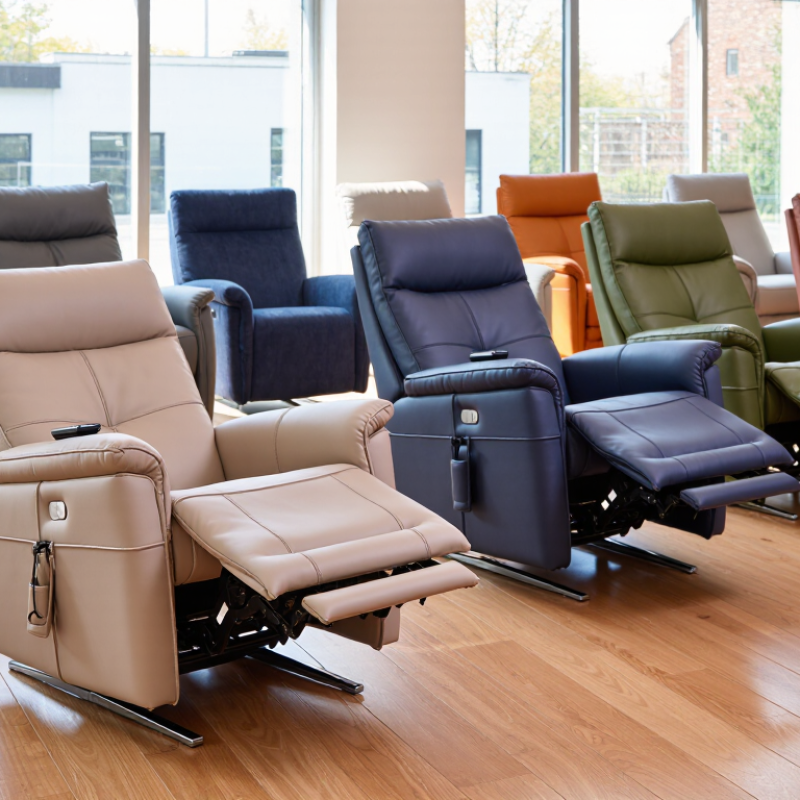
China’s power lift chair market spans domestic retail, contract manufacturing, and export supply. Buyers can find compact chairs for apartments, wider models for easier transfers, and upholstery suited to different climates. Fit comes first. Check seat width, seat height, and the distance from the chair to nearby walls; a reclined chair needs room to move.
A 2-motor design usually adjusts the backrest and footrest separately. This gives users more control over their sitting position than a single-motor mechanism, though the chair may still move both sections in coordinated ways. A 3-motor model adds another independent adjustment, often for the headrest or lumbar support. The exact function varies by design, so confirm what each control does rather than relying on the motor count alone.
For sourcing, ask manufacturers for load-capacity details, operating-cycle test records, warranty terms, and spare-parts availability. Inspect the hand control, frame joints, and upholstery seams, not just the showroom finish. Battery backup may help return a chair during a power outage, but its function and limits should be checked. One detail is easy to overlook: a more adjustable chair can feel less intuitive. Requesting a demonstration with the intended user can reveal that early.
China’s Power Lift Chair Market: 2-Motor vs. 3-Motor Designs
A design-focused comparison of the typical independently controlled adjustment functions—not manufacturer rankings or market-share data.
In common configurations, two-motor chairs provide separate backrest and legrest adjustment, while the lift motion is coordinated with the reclining mechanism. Three-motor designs typically add independent lift control. Features vary by model, so buyers should confirm the product specification.
Trace the Lift Cycle: Actuators, Hand Controls, Load Ratings, and Recline Range
When comparing China’s power lift chair manufacturers, trace the full movement cycle rather than judging a chair by its upholstery. The actuator moves the chair from a seated position into lift and recline. Single-motor designs often link movements, while dual-motor systems may adjust the backrest and footrest independently. Confirm what each hand control does. Ask for a demonstration using the manufacturer’s specified test load, and watch for pauses, rubbing, or abrupt transitions. A smooth showroom cycle is useful, but it cannot prove long-term durability. Small details matter.
Check that hand-control buttons are easy to distinguish and that the cord reaches the user’s preferred side without crossing a walkway. Ask whether replacement controls and actuator specifications are documented. Verify the rated load in the product sheet, and clarify the conditions behind that rating. Never infer capacity from frame appearance. Leave a margin rather than choosing a chair at its stated limit. Test it loaded. Compare the recline range at transfer, television-viewing, and resting positions. Measure floor and wall clearance throughout the cycle; some chairs travel farther back than expected. Catalogs may list angles without explaining how they were measured. Request drawings or a live measurement, then record the figures before comparing quotations.
Check Product Testing Against IEC 60335-2-116 and ISO 7173
For a power lift chair, ask for test reports tied to the exact model and configuration—not a general statement that the product is “tested.”
IEC 60335-2-116 addresses safety requirements for furniture with electrically motorized parts, alongside the relevant general appliance-safety requirements. Check whether the report covers the chair’s motor, handset, wiring, and moving sections. Look for documented checks of electrical safety and hazards created as the seat rises or reclines.
Pinch points matter.
ISO 7173 provides methods for assessing chair strength and durability.
Ask which tests were performed and how the tested chair was set up. A report should identify the model, test conditions, and results, rather than simply list the standard number.
Inspect practical details too: frame joints, footrest movement, and stability during lifting.
Small details count.
Standards do not automatically show how a chair will perform in every home, or whether its fit suits a particular user.
Reports can also be hard to compare when editions or test configurations differ. Request the dated laboratory report, confirm the applicable editions, and clarify any limits before comparing manufacturers.
Compare 10 Chinese Manufacturers by Capacity, OEM Services, and Export Experience
Comparing ten Chinese power lift chair manufacturers is more useful as a sourcing audit than as an unsupported ranking. Assess monthly output, production lines, and lead times separately. Ask for recent capacity records, not just a factory’s headline figure. One weakness in many comparisons is that capacity data may be self-reported. Verify it.
Demand context matters, but it does not prove supplier quality. The World Health Organization’s 2024 ageing and health report estimates that one in six people worldwide will be aged 60 or older by 2030, up from one in eleven in 2019. For buyers, this supports checking durable mechanisms, clear operating instructions, and options suited to different users. It does not justify assuming every chair needs the same design.
Compare OEM services through specific evidence: frame and upholstery choices, control options, packaging tests, and sample approval steps. Ask who handles drawings and how revisions affect cost and timing. Export experience should be checked through destination-market history, shipping documents, and references from repeat buyers. A long customer list alone proves little. Request anonymized shipment records where confidentiality applies, then compare the ten suppliers using the same questions and dated evidence.