CALL TODAY for FREE In home consultation
SEND EMAIL
1995 East Norse Avenue
Cudahy, Wisconsin 53110
414-727-2524
4445 W Forest Home Avenue
Milwaukee, Wisconsin 53219
414-727-2525
2140 American Drive
Neenah, Wisconsin 54956
920-257-6060
65 Copeland Avenue
La Crosse, Wisconsin 54603
608-784-9980
Choosing a Picosecond Laser starts with the treatment goal, not the product brochure. Tattoo pigment, uneven pigmentation, and skin rejuvenation require different settings and clinical judgment. A device’s wavelength, pulse duration, spot size, and energy range all matter. So does the operator’s training. A polished specification sheet cannot predict every patient’s response.
The market is expanding, but market growth is not proof that one platform works best. Grand View Research estimated the global aesthetic lasers market at USD 1.4 billion in 2023, with projected growth through 2030. That figure covers aesthetic lasers broadly, not picosecond systems alone. It offers context, not a purchasing verdict. Clinical evidence and intended use should carry more weight than market momentum.
The physics offers a practical starting point. In their foundational paper, laser researchers R. Rox Anderson and John Parrish described “precise microsurgery by selective absorption of pulsed radiation.” Their principle helps explain why wavelength and pulse duration must suit the target. Ask whether published studies match the device, indication, and patient group under consideration. Check service support, calibration procedures, and realistic treatment settings, too. Look closely.
The best choice is rarely the machine with the longest feature list. It is the system whose evidence, safety controls, and capabilities fit the clinic’s actual needs. Compare carefully. Some uncertainty remains: published results may not predict every real-world outcome. That deserves honest attention.
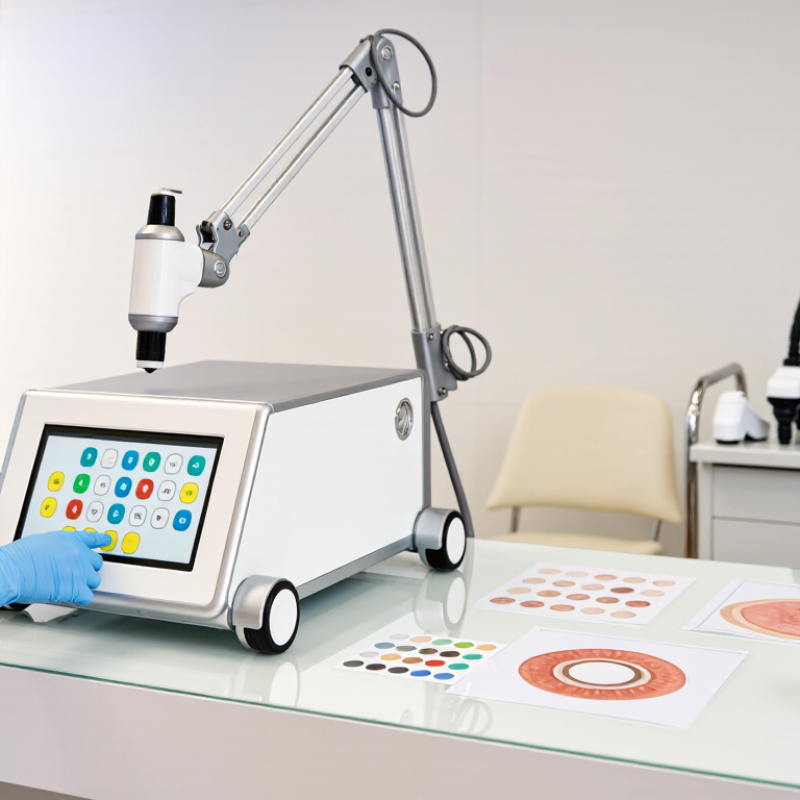
A picosecond laser delivers energy in pulses lasting one trillionth of a second. That speed matters. Instead of relying mainly on heat, it creates a rapid photomechanical effect. Pigment particles absorb the light and break into smaller fragments. The body can then clear these fragments gradually. Some systems also stimulate collagen through controlled skin disruption, depending on the wavelength and treatment settings.
Different wavelengths reach different depths and target different concerns. Dark spots, unwanted tattoo pigment, acne scars, and uneven texture may require separate approaches. The device alone does not determine the result. Skin type, pigment depth, pulse energy, and treatment intervals all influence safety and effectiveness.
A qualified dermatologist or licensed medical practitioner should assess these factors before treatment. Protective eyewear is essential, and cooling may reduce discomfort. Mild redness can occur, but blistering, burns, or lasting color changes need medical attention.
The word “picosecond” can sound like a guarantee. It is not. Results vary. Even experienced clinicians may adjust settings during a treatment plan. I would question any promise of instant, risk-free perfection. A careful consultation should include medical history, recent tanning, medications, and realistic recovery expectations. Choosing the best picosecond laser begins with understanding the technology, then matching it to the person rather than chasing the shortest pulse.
Picosecond lasers deliver ultra-short pulses that fragment pigment with limited heat. They are commonly used for unwanted tattoos, sun spots, freckles, and certain brown marks. A 2023 systematic review in Lasers in Medical Science found that many pigment studies used three to six treatment sessions. Results varied by wavelength, skin type, and lesion depth. Darker skin needs careful energy selection. Otherwise, post-inflammatory hyperpigmentation may appear.
These lasers may also improve acne scars, enlarged pores, and fine lines. A 2022 review of fractional picosecond treatments reported visible texture improvement across several clinical studies. However, the evidence remains uneven.
Some studies included small patient groups and short follow-up periods. That matters. A smoother cheek after eight weeks does not prove permanent remodeling.
Melasma requires extra caution because heat and inflammation can trigger recurrence. Clinical assessment should check hormone patterns, sun exposure, previous reactions, and active skin disease. The American Academy of Dermatology recommends daily broad-spectrum sunscreen after procedures, because ultraviolet exposure can worsen discoloration. In practice, healing is not always predictable. Mild redness may last several days, while pigment changes can persist longer. A qualified medical practitioner should match pulse settings, wavelength, and treatment spacing to the specific concern, not simply choose the strongest device.
Choosing the best picosecond laser requires more than comparing prices or advertised power. The key is understanding how each technology delivers energy to the skin. Picosecond pulses are extremely short, but pulse quality can vary between systems. Ask for measured pulse duration, wavelength options, fluence range, and spot-size flexibility. These details influence treatment precision, comfort, and suitable skin concerns.
Tips: Request technical documentation and independent clinical evidence. Check whether the device includes adjustable cooling, stable beam delivery, and clear safety controls. Confirm that operators receive proper training and understand different skin types. A reliable supplier should explain maintenance schedules, calibration records, and service response times. Do not rely on demonstrations alone.
In practical evaluations, consistent energy delivery often matters more than impressive peak specifications. A larger spot may improve efficiency, while a smaller spot can support detailed work. Multiple wavelengths may increase versatility, but they also require stronger operator knowledge. Consider the treatment room, patient profile, and expected workload. Some comparisons remain uncertain because published studies use different settings and outcome measures. That limitation deserves attention. I would also test usability, handpiece balance, interface clarity, and recovery guidance before making a decision. The most advanced feature is not always the most useful one.
How to Choose the Best Picosecond Laser?
What Safety Standards and Treatment Factors Should You Check?
A picosecond laser is only as safe as its setup and operator. Check whether the clinic follows ANSI Z136.3-2018, the American National Standard for safe laser use in healthcare. Ask how staff verify protective eyewear matches the device’s wavelength and optical density. It must fit securely. The U.S. Food and Drug Administration also advises using appropriate eye protection during laser procedures. Ask to see the device’s maintenance and safety records, not just its treatment brochure.
Treatment settings matter. Wavelength, pulse energy, spot size, and skin tone all affect how pigment absorbs light. Published clinical reviews of picosecond laser treatments describe temporary redness and swelling, while blistering and pigment changes can also occur. Results vary by indication, ink color, and number of sessions; a promised session count is not a guarantee. A careful clinician should review your medical history, explain alternatives, and test a small area when appropriate. That discussion can feel less exciting than a dramatic before-and-after photo, but it is more useful.
Tips: Ask what endpoint the clinician watches for, such as mild whitening or redness, and how they will respond if your skin reacts unexpectedly. Confirm aftercare instructions, including sun avoidance and whom to contact about worsening pain or blistering. Take your time.
Choosing a picosecond laser for your clinic requires more than comparing pulse duration or purchase price. Start with your patient profile, common indications, and treatment room limitations. A device should offer suitable wavelengths, adjustable fluence, practical spot sizes, and reliable cooling for the cases you actually manage.
Ask for documented clinical evidence, training materials, and maintenance support. Experienced clinicians will also examine handpiece weight, interface clarity, treatment speed, and calibration procedures. These details affect daily consistency. Skin type matters, too. Conservative settings, careful assessment, and test spots can reduce avoidable complications. No laser is perfect. Your selection may still involve compromises.
Tips: Observe a live demonstration. Request service records. Confirm staff training. Check whether the supplier explains contraindications clearly. Review treatment protocols before purchase. Ask how quickly technical support responds. Do not rely on impressive sample images alone. Patient outcomes depend on diagnosis, settings, technique, and aftercare. A reflective review of your first treatments can reveal gaps in training or workflow. That feedback is valuable, even when it is uncomfortable. Also verify that the equipment, operator credentials, and clinical procedures meet applicable local requirements.
1995 E Norse Ave
Cudahy, WI 53110
Phone: 414-486-6249
Fax: 414-486-5728