
What Are the China Top 10 Foot Heel Massager Manufacturers?
The China Top 10 Foot Heel Massager Manufacturers deserve closer attention as wellness spending moves toward practical, home-based recovery. Grand View Research reports that the global massage equipment market is expanding steadily, supported by rising health awareness and aging populations. Its analysis also highlights smart controls, compact designs, and improved user comfort as important product trends.
A Foot Heel Massager is no longer judged only by vibration strength. Buyers now examine heat consistency, pressure distribution, noise levels, material safety, and cleaning convenience. The World Health Organization identifies musculoskeletal conditions as a major global health burden, which helps explain demand for accessible personal-care devices. However, a massager is not a medical treatment. Responsible manufacturers should communicate this distinction clearly.
This guide compares ten Chinese manufacturers using practical purchasing criteria. These include factory experience, OEM and ODM capability, quality-management systems, export records, product testing, and after-sales support. Information is cross-checked through company documentation, trade records, product samples, and recognized industry research where available.
Rankings vary.
There is no single official list of China’s leading manufacturers. Some companies specialize in retail brands, while others quietly produce large volumes for international buyers. That difference can distort online comparisons. This review therefore focuses on verifiable manufacturing strength rather than advertising visibility. Readers should still request current certifications, test reports, production photos, and sample units before placing an order. A polished catalogue is useful, but factory evidence matters more.
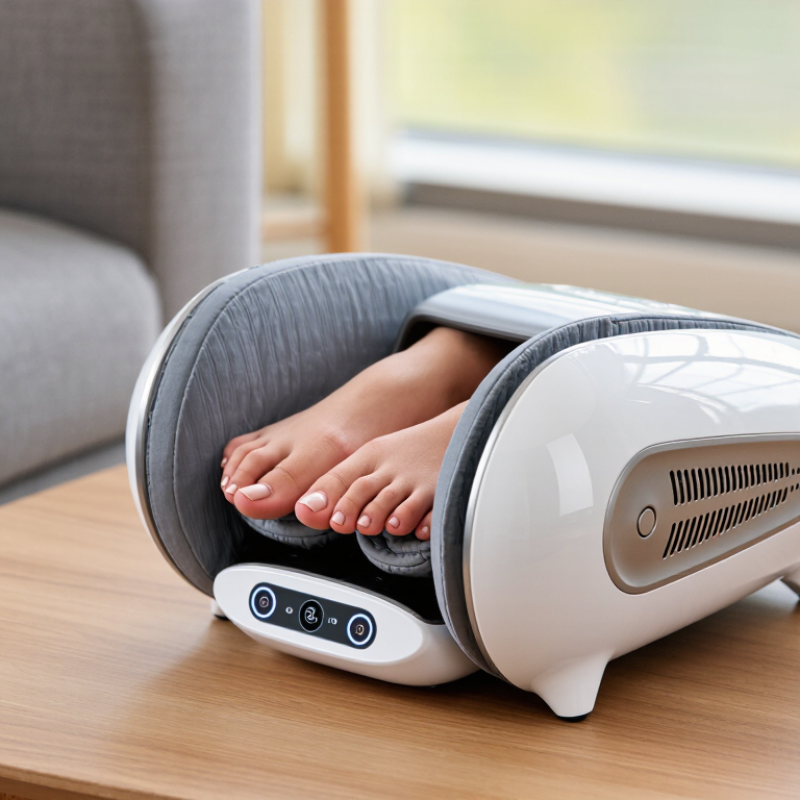
What Defines a Leading China Foot and Heel Massager Manufacturer?
What Are the China Top 10 Foot Heel Massager Manufacturers?
What Defines a Leading China Foot and Heel Massager Manufacturer?
A leading China foot and heel massager manufacturer offers more than a low factory price. It shows repeatable production, trained technicians, and clear quality records. During supplier evaluations, buyers should inspect assembly lines, component storage, and final testing areas. Clean workstations matter. So does traceability.
Reliable manufacturers select skin-friendly materials, stable motors, and durable heating elements. They test pressure strength, temperature control, noise levels, and electrical safety before shipment. A practical sample should run through several cycles, not just look attractive in a showroom. Technical teams should explain air pressure settings, massage programs, and expected product life in simple language.
Experienced factories also support product development. They can adjust heel coverage, foot size, control panels, packaging, and user instructions. However, customization sometimes weakens quality control. This point deserves attention. A factory may promise fast changes, yet lack enough testing equipment for revised parts. Buyers should request inspection reports, sample approval records, and production timelines. Independent audits can reveal gaps that sales conversations hide.
Professional communication is another useful measure. A dependable manufacturer reports defects honestly and offers corrective actions with dates. It should maintain consistent records for incoming materials and finished units. After-sales support matters too, especially when replacement parts or technical guidance are needed. The strongest suppliers are not always the largest. They are the ones that combine engineering discipline, transparent evidence, and steady improvement. Mistakes still happen. Responsible factories learn from them.
What Are the China Top 10 Foot Heel Massager Manufacturers? - What Defines a Leading China Foot and Heel Massager Manufacturer?
| Rank | Defining Dimension | Recommended Benchmark | Relevant Evidence or Standard | Why It Matters for Foot and Heel Massagers |
|---|---|---|---|---|
| 1 | Quality Management System | Documented incoming inspection, process control, final inspection, and corrective-action procedures | ISO 9001 certificate or equivalent auditable quality records | Helps maintain consistent massage intensity, heating performance, assembly quality, and product reliability. |
| 2 | Electrical and Product Safety | Risk assessment, insulation checks, leakage-current testing, grounding verification, and burn-in testing | Applicable requirements of IEC 60335-1 and IEC 60335-2-32 for massage appliances, where applicable | Foot massagers combine motors, electrical controls, pressure mechanisms, and sometimes heated surfaces. |
| 3 | Temperature and Overheating Protection | Independent temperature control, automatic shut-off, thermal fuse, and abnormal-operation testing | Test reports showing temperature limits under normal and blocked-airflow conditions | Heating elements require controlled temperatures to reduce burn, fire, and component-damage risks. |
| 4 | Electromagnetic Compatibility | Emissions and immunity testing completed for the intended sales market | CISPR 14-1 and CISPR 14-2 or the applicable regional EMC requirements | Electronic controls should not create unacceptable interference or malfunction when exposed to normal disturbances. |
| 5 | Material and Chemical Compliance | Controlled material declarations for plastics, cables, adhesives, coatings, and electronic components | RoHS and REACH documentation when products are supplied to applicable markets | Supports regulatory compliance and reduces the risk of restricted substances entering the supply chain. |
| 6 | Mechanical Durability | Load testing, repeated-cycle testing, cable-bending tests, switch-life testing, and housing-impact checks | Supplier-defined reliability protocols with recorded pass/fail results and sample sizes | Repeated foot pressure and moving massage components can stress gears, rollers, cushions, seams, and housings. |
| 7 | Massage and Ergonomic Design | Adjustable intensity, suitable foot-size range, stable heel support, washable contact surfaces, and accessible controls | Product specifications, user trials, dimensional drawings, and cleaning instructions | Comfort, fit, hygiene, and ease of operation strongly affect user acceptance and repeat purchases. |
| 8 | OEM and ODM Capability | Ability to support private labeling, packaging adaptation, firmware or control changes, and product customization | Approved drawings, prototype records, tooling agreements, and change-control procedures | Importers often require market-specific designs, packaging, manuals, plugs, voltage, and control interfaces. |
| 9 | Traceability and Supply-Chain Control | Batch coding, component traceability, approved supplier lists, and documented inspection records | Production records linking finished units to components, operators, dates, and inspection results | Traceability makes recalls, defect investigations, warranty analysis, and corrective actions more efficient. |
| 10 | After-Sales and Export Support | Spare-parts availability, repair instructions, warranty process, multilingual documentation, and export packaging controls | Service-level agreement, warranty terms, replacement-part list, packaging test records, and product manuals | Reliable support lowers total ownership cost and helps overseas distributors manage returns and customer service. |
Note: The ranking presents ten evidence-based criteria for evaluating leading manufacturers; it does not disclose company or brand names.