2026 Best Mobility Lift Types for Global Buyers?

Choosing the best mobility lift in 2026 requires more than comparing prices and lifting capacities. Global buyers face different homes, climates, languages, currencies, and installation conditions. A lift that performs well in a dry apartment may struggle in a humid coastal house. Practical details matter.

Ronald Mace, a pioneer of universal design, described the goal as “the design of products and environments to be usable by all people, to the greatest extent possible.” His principle remains valuable for mobility lift selection. Buyers should examine stair lifts, platform lifts, vertical platform lifts, vehicle lifts, and portable access solutions. Each type serves a different space and user need. A narrow staircase may require a curved rail. A wheelchair user may need a platform lift with a level entry. Outdoor installations need weather-resistant controls and protected electrical components.

Capacity is only one part of the decision. Door width, landing space, battery backup, emergency lowering, noise, maintenance access, and local installation support also deserve attention. Certification requirements can vary between markets, so buyers should request clear technical documents and verified service information. Manufacturer claims need checking.

There is no universal winner. That sounds obvious, but product comparisons often simplify real homes. I may also focus too heavily on specifications. User confidence matters just as much. A reliable mobility lift should move smoothly, stop accurately, and remain understandable during an unexpected power failure. This guide compares leading lift types through safety, accessibility, lifecycle cost, installation complexity, and after-sales reliability. The right choice is not always the most advanced model. It is the one that fits the user, building, and local support network.
2026 Best Mobility Lift Types for Global Buyers?

Mobility Lifts: Definition, Purpose, and Main Applications

Mobility lifts are mechanical assistive devices that raise, lower, or transfer people safely between levels or locations. Common types include stair lifts, vertical platform lifts, inclined platform lifts, patient hoists, vehicle lifts, and pool lifts. Their purpose is practical: reduce falls, support caregivers, and preserve daily independence.

The need is substantial. WHO and UNICEF’s Global Report on Assistive Technology (2022) estimates that more than 2.5 billion people require at least one assistive product. This figure may exceed 3.5 billion by 2050. WHO also reports that about 1.3 billion people experience significant disability worldwide. These figures show why mobility lifts serve homes, hospitals, rehabilitation centers, public buildings, and accessible transport systems.

Global buyers should match the lift to the user, building, and maintenance capacity. A stair lift suits seated travel along existing stairs. A vertical platform lift works better for wheelchairs and short height changes. Patient hoists support bed-to-chair transfers, but trained caregivers remain essential. Vehicle lifts help transport scooters, though storage space and loading weight can become difficult.

Buyers should check rated load, platform size, emergency lowering, power backup, installation quality, and local conformity requirements. ISO 10535:2021 provides relevant testing guidance for mobile hoists and stand-up lifts.

A powerful lift is not automatically the best lift. Poor site assessment can create expensive problems. Even reliable equipment needs inspection, cleaning, and human judgment.

Key Mobility Lift Types and How Each One Works

2026 Best Mobility Lift Types for Global Buyers

Key Mobility Lift Types and How Each One Works

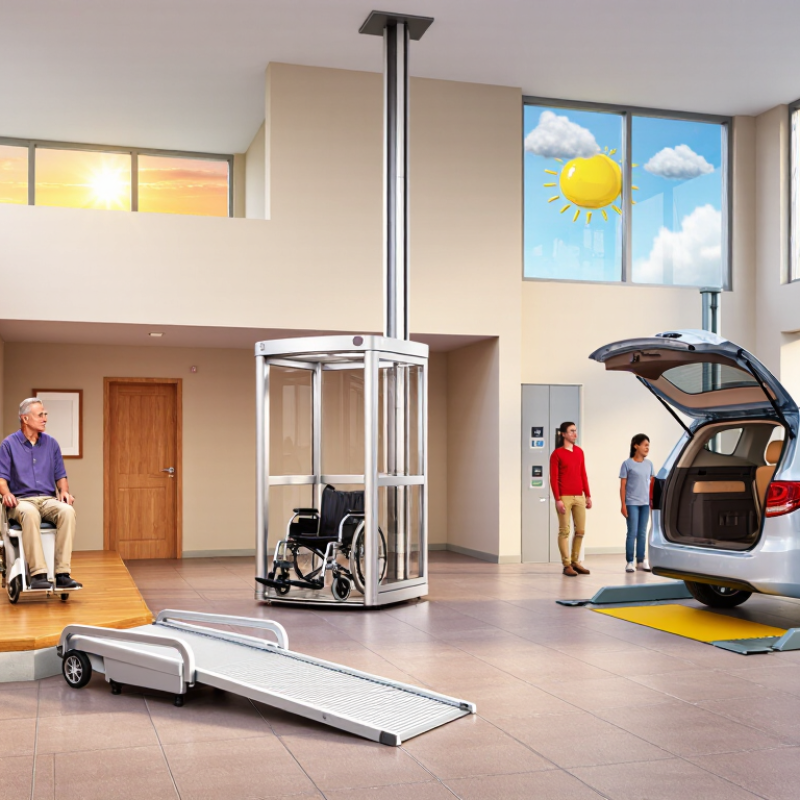
Mobility lifts solve different access problems, so buyers should match the mechanism to the building. A stair lift uses a motorized chair moving along a rail fixed beside the stairs. It suits users who can transfer into a seat safely. Straight rails are simpler, while curved rails require accurate measurements and stronger installation planning. A vertical platform lift moves a wheelchair platform between floors through a guided shaft or enclosed structure. It needs landing space, power, and careful weight-capacity checks. It is useful where ramps would become too long or steep.

An inclined platform lift follows a staircase and carries a wheelchair directly. The platform folds when unused, but the staircase must remain wide enough for safe passage. A porch lift, usually installed outdoors, raises a wheelchair between ground level and a doorway. Weather protection matters. Water, ice, and poor drainage can shorten service life. Vehicle lifts use a powered platform or hoist to load mobility equipment into a vehicle. Their fit depends on vehicle clearance, loading angle, and secure restraints.

During site assessments, I measure turning areas, door widths, stair geometry, and emergency access. Small details matter. A lift can meet its stated capacity yet feel unsuitable in daily use. Noise, transfer height, control reach, and backup lowering should be tested with the intended user. Product documents help, but real movement reveals problems. I would not rely on photographs alone. A drawing can look correct and still hide an awkward landing or uncomfortable approach. Local installation requirements also vary, so qualified inspection should guide the final decision.

2026 Best Mobility Lift Types for Global Buyers

Key Mobility Lift Types and How Each One Works

The chart compares indicative maximum rated load capacities commonly found across major mobility lift categories. Vertical platform lifts generally support the highest loads, while stairlifts are designed for individual seated users. Actual specifications vary by model, installation conditions, and local safety regulations.

Stairlifts carry a seated passenger along a rail; vertical platform lifts move a wheelchair or person between floor levels; inclined platform lifts travel on stairways; patient lifts transfer users between beds, chairs, and other surfaces; ceiling lifts move users along an overhead track.

Comparing Capacity, Installation, Safety, and Accessibility Features

For global buyers in 2026, mobility lift selection should begin with real user needs, not catalog capacity. The WHO Global Report on Health Equity for Persons with Disabilities estimates that 1.3 billion people experience significant disability worldwide.

A loaded wheelchair, user, caregiver, and shopping bag can quickly exceed a small platform lift’s practical limit. I would measure the complete load, turning radius, doorway width, and landing space before comparing models.

That step is often missed.

Vertical platform lifts suit short rises and offer level access, while stair lifts usually require less structural alteration. Inclined platform lifts can preserve stair access but need wider, unobstructed stairways.

Ceiling-based lifts support transfers, not independent floor travel. Installation conditions vary sharply between homes, hospitals, and public buildings.

Check the applicable requirements, including EN 81-41 or ASME A18.1, because approval routes differ by country.

Safety features should include emergency lowering, obstruction detection, non-slip platforms, grab rails, door interlocks, and battery backup. Accessibility also depends on control height, tactile markings, audible alerts, and enough space for turning.

The United Nations Disability and Development Report identifies accessibility as a persistent barrier to equal participation. Capacity alone cannot solve it. A lift may meet its rating yet remain difficult to use. That uncomfortable detail deserves a site test before purchase.

Global Standards, Space Requirements, and Buying Considerations

2026 Best Mobility Lift Types for Global Buyers?

Mobility lift selection starts with the building, not the product brochure. The WHO Global Report on Health Equity for Persons with Disabilities (2022) estimates that 1.3 billion people experience significant disability worldwide. That figure makes accessible circulation a planning issue, not a niche upgrade. Stairlifts suit narrow residential stairs, while inclined platform lifts better serve wheelchair users. Vertical platform lifts work well beside entrances, split levels, and short outdoor rises.

Measure twice.

Record stair width, landing depth, headroom, door swings, drainage, and emergency access. A lift may fit the shaft but block a fire route. EN 81-40 covers stairlifts and inclined lifting platforms. EN 81-41 addresses vertical lifting platforms. ISO 9386-1 provides international safety requirements for powered lifting platforms. Regional rules still control installation, guarding, electrical work, and inspection. ADA 2010 requirements may apply in the United States, while other markets may follow different accessibility codes.

Buyers should request load testing, maintenance intervals, battery performance, weather resistance, and manual lowering procedures. Ask for technical files and local service capacity. A 300-kilogram platform can need more turning space than expected. Outdoor models also require careful attention to rainwater, salt, and uneven paving. Industry guidance often simplifies these details. Real sites do not. A careful survey remains essential, although even professional measurements can miss future furniture, caregivers, or changing user needs.

2026 Best Mobility Lift Types for Global Buyers?

Global Standards, Space Requirements, and Buying Considerations

Comparative guide to commonly specified mobility lift categories
Lift type Best-fit application Typical travel and capacity Representative planning dimensions Common international standards or regulations Main advantages Key limitations and buying checks
Vertical Platform Lift
(Open Type)
Short vertical changes in level at entrances, porches, terraces, and split-level interiors. Usually about 0.5–3 m of travel; commonly 225–340 kg rated load, depending on configuration. Platform commonly about 900–1,100 mm wide × 1,250–1,500 mm deep; allow clear approach and landing space. EN 81-41 in applicable European markets; ASME A18.1 in North America; local building, electrical, guarding, and accessibility rules also apply. Compact installation, generally no full shaft, suitable for wheelchair users, and often practical for low-rise access. Weather protection may be required outdoors. Confirm pit or ramp requirements, guard height, gate interlocks, emergency lowering, drainage, and local inspection obligations.
Vertical Platform Lift
(Enclosed or Shafted)
Multi-level access in homes, public buildings, schools, clinics, and commercial premises where enhanced protection or visual integration is needed. Often about 2–6 m of travel in low-rise applications; commonly 300–450 kg rated load, subject to design. Typical internal platform sizes range from approximately 900 × 1,250 mm to 1,100 × 1,400 mm; shaft and landing dimensions can substantially increase the footprint. EN 81-41, ASME A18.1, and national construction and lift regulations where applicable; fire-rated construction may be required for some shaft arrangements. Better protection from weather and moving parts; serves several floors and can provide a more permanent building solution. Requires careful structural coordination, landing doors or gates, electrical capacity, maintenance access, and potentially planning or permitting approval.
Inclined Platform Lift Wheelchair access along an existing straight staircase in residential, institutional, and public buildings. Usually follows one staircase flight; commonly about 225–300 kg rated load, with project-specific limits. Often needs approximately 900–1,100 mm of usable stair width, plus parking space at the top and bottom; folded platform depth varies by design. ASME A18.1 in North America; EN 81-40 is commonly referenced for stairlifts and inclined lifting equipment in European contexts; verify the exact product classification locally. Uses the existing staircase and can avoid major vertical construction work. May reduce usable stair width, usually requires a relatively straight and structurally suitable stair, and can be slower than a conventional passenger lift.
Seated Stairlift Individual users who can transfer to a seat and need assistance on straight or curved stairs. Typically one staircase flight; commonly about 120–160 kg rated load, with heavy-duty models requiring separate verification. Often suitable for stairs approximately 700–900 mm wide, but the folded seat and rail return require additional clearance at landings. EN 81-40 in applicable European markets; ASME A18.1 in North America; electrical and accessibility requirements vary by jurisdiction. Usually needs less space and less construction than a platform lift; available for many straight and curved stair layouts. Not suitable for users who must remain in a wheelchair. Check transfer ability, seat position, stair width, battery backup, swivel-seat safety, and obstruction sensors.
Low-Rise Home Lift
(Cabin or Car Lift)
Frequent access between two or more floors where a fully enclosed cabin, higher comfort, or broader user access is desired. Commonly 2–6 stops and approximately 3–12 m of travel; rated load often ranges from 250–450 kg in residential-scale designs. Cabin footprints commonly start near 1,000 × 1,250 mm; a wheelchair-friendly layout may require approximately 1,100 × 1,400 mm or more, plus shaft and machine-space allowances. Depending on design and market, EN 81-20/50, EN 81-70, EN 81-41, ASME A17.1/CSA B44, or other national lift codes may apply. Confirm classification before purchase. Most comfortable option for repeated multi-floor use; can accommodate wheelchair users and, in some designs, an attendant. Highest construction and compliance complexity among the listed options. Check pit, overhead, shaft, fire safety, ventilation, power supply, rescue procedures, and inspection requirements.
Ceiling-Mounted Patient Lift Transfer of a person between a bed, wheelchair, toilet, or bathing area in healthcare and accessible-care environments. Short transfer distances along a ceiling track; commonly about 150–250 kg safe working load, depending on the system and sling. Requires structural track planning rather than a floor shaft; transfer zones commonly need about 900–1,200 mm of maneuvering clearance around care equipment. ISO 10535 is widely used for hoists for the transfer of disabled persons; local medical-device, electrical, workplace-safety, and building requirements may also apply. Reduces manual handling and keeps floor space open; particularly useful where the user cannot safely transfer independently. Does not provide floor-to-floor transportation. Verify ceiling structure, track loading, sling compatibility, caregiver training, emergency lowering, and planned maintenance.

Global buying considerations

  • Treat all dimensions and capacities above as representative planning ranges, not as universal code requirements. Obtain final dimensions from an approved site survey and the applicable local authority.
  • Confirm the destination country’s conformity assessment, electrical voltage and frequency, wiring rules, accessibility requirements, inspection process, and import documentation before ordering.
  • For wheelchair access, measure the complete wheelchair, user, attendant, turning envelope, door clear width, landing depth, and approach route rather than relying only on nominal platform size.
  • Compare total cost of ownership, including civil works, delivery, installation, permits, commissioning, preventive maintenance, batteries, replacement parts, warranty support, and emergency service response.
  • Require documented emergency lowering or rescue procedures, obstruction protection, interlocks, load testing, user instructions, and a maintenance schedule appropriate to the installation environment.

Standards and regulatory applicability can change by country, building type, and lift classification. Always verify the current edition and local adoption requirements before specification or purchase.

How to Choose the Best Mobility Lift for Different User Needs

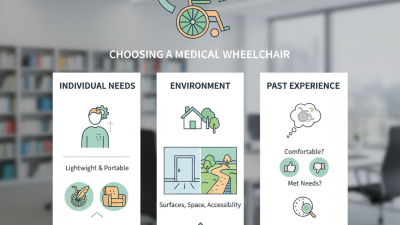
Choosing the best mobility lift begins with the user, not the product category. A person who walks short distances may need a compact stair lift with supportive seating. Someone using a wheelchair may require a platform lift or a vertical lift. These options solve different problems. A transfer lift can help caregivers move a user between a bed and a wheelchair. However, it may not suit someone with limited trunk control or severe discomfort during transfers.

The home environment matters just as much. Measure stair width, landing space, doorway clearance, floor strength, and available power. A lift can look suitable in a brochure but fail at a narrow hallway. Check the user’s weight, posture, transfer ability, and daily routine with a qualified occupational therapist or mobility professional. Caregivers should test controls, emergency lowering, seat belts, and battery backup. Simple controls matter. Poor lighting matters too.

Vehicle access creates another decision. A hoist may work for a powered wheelchair, while a ramp may suit a lighter manual chair. Consider loading height, storage space, weather exposure, and caregiver strength. Do not select only by maximum capacity. Real comfort, maintenance access, noise, and service response can determine long-term value. A checklist helps, but it can miss personal hesitation. The user may feel unsafe on a lift that meets every measurement. A supervised trial is often worthwhile, even when the planning process feels complete.

ACCESS ABILITY Home Medical Store has a Beautiful showroom in Cudahy To Serve You!

Corporate Office And Store
Cudahy, Wisconsin

1995 E Norse Ave
Cudahy, WI 53110
Phone: 414-486-6249
Fax: 414-486-5728